
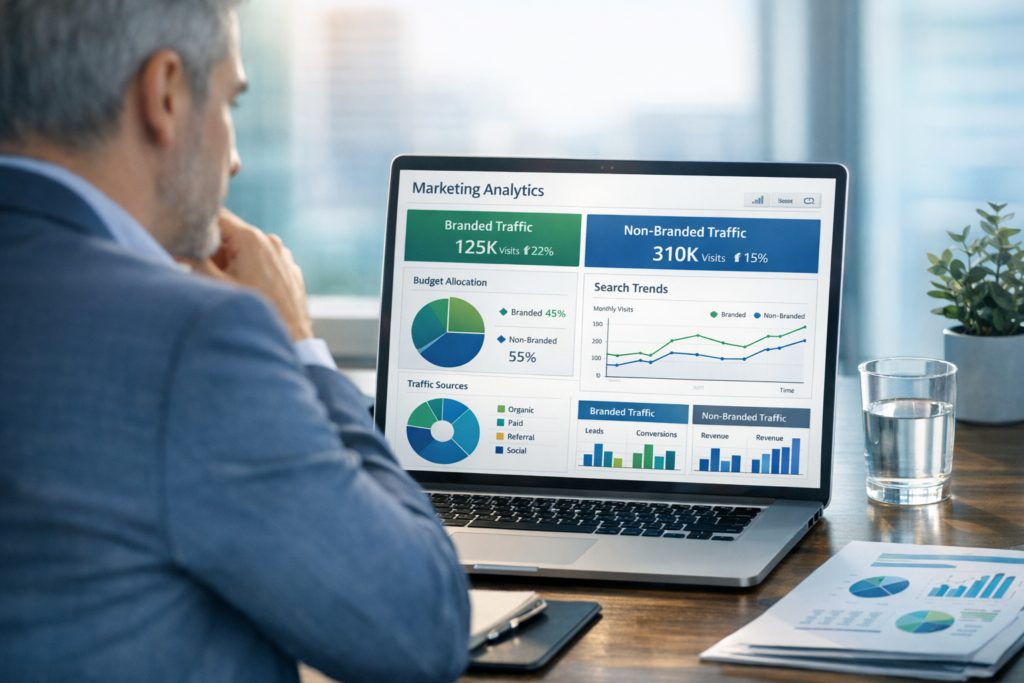
To get full clarity on where money is going, separate branded traffic from non-branded traffic in your analytics. This shows whether performance comes from existing brand awareness or new customer discovery, making it easier to measure SEO, PPC, and content accurately, allocate budget wisely, and identify which channels drive truly incremental growth.
Separate Branded Traffic for Clearer Budget Insight
If you want full clarity on where money is going, you need to separate branded traffic from non-branded traffic in your analytics and reporting. That split shows whether growth comes from existing brand demand or from new customer discovery, helping you allocate budget more accurately across SEO, PPC, content, and awareness campaigns.
When you are building toward a bigger vision for your business, unclear reporting can feel frustrating. You want to dream bigger, invest with confidence, and know exactly what each channel is doing. But when branded and non-branded traffic are mixed together, the picture gets blurry fast.
That is why learning to separate branded traffic is one of the most useful things you can do in marketing analytics. It gives you a cleaner view of demand, performance, and return on investment. More importantly, it helps you understand whether your budget is capturing people who already know you or creating new opportunities with people who do not.
In this guide, you will learn what branded traffic means, why the distinction matters, how to track it across channels, and how to turn that insight into smarter decisions. If your goal is full clarity on where money is going, this is the reporting foundation you need.
What does it mean to separate branded traffic?
To separate branded traffic means dividing visits, clicks, impressions, and conversions into two groups:
- Branded traffic: People who searched for your company name, product name, trademark, or close brand variations.
- Non-branded traffic: People who searched for generic terms, category terms, problem-based queries, or competitor comparisons without using your brand name.
For example, if your brand is “Northlane Finance,” these would likely be branded searches:
- Northlane Finance
- Northlane pricing
- Northlane Finance login
- Northlane reviews
These would likely be non-branded:
- best budgeting software for teams
- how to track marketing spend
- expense reporting tools
- software to monitor ad budget
That distinction matters because branded traffic often performs differently. It usually converts better, costs less in paid search, and reflects existing awareness. Non-branded traffic, on the other hand, often shows how well your marketing is creating new demand.
Why is it important to separate branded traffic?
When branded and non-branded data are combined, performance can look stronger than it really is. A report may show rising traffic or lower cost per acquisition, but much of that success could be coming from people who already knew your brand.
When you separate branded traffic, you get clearer answers to critical questions:
- Are SEO gains coming from better rankings for brand terms or from new topic visibility?
- Is paid search capturing existing demand or expanding reach?
- Are awareness campaigns increasing branded search volume over time?
- Is your content generating new customer discovery or mainly supporting current demand?
- Which part of the budget is driving incremental growth?
This is especially valuable if you care about financial clarity. Without segmentation, you can over-invest in channels that appear efficient simply because they benefit from strong brand recognition. With segmentation, you can see where money is maintaining demand versus where it is creating it.
How does branded traffic affect budget decisions?
Budget decisions become smarter when you understand intent. Branded visitors are typically lower-funnel. They are closer to action because they already know who you are. Non-branded visitors are often earlier in the journey and may need more education before converting.
That means each traffic type should be evaluated differently.
Branded traffic usually helps you measure:
- Brand awareness already built in the market
- Demand capture efficiency
- Navigational search behavior
- Retention and repeat engagement
Non-branded traffic usually helps you measure:
- Market expansion
- Top-of-funnel discovery
- Content reach
- Incremental acquisition potential
Imagine your paid search campaign has a low cost per conversion. That sounds great until you realize most conversions came from branded terms. In that case, the campaign may be protecting demand rather than generating new business. That is still valuable, but it should be budgeted and reported differently.
For a business owner or marketing leader who wants confidence, this distinction is powerful. It turns vague marketing reports into practical financial insight.
What channels should you analyze when you separate branded traffic?
You should apply this split across the channels where search intent or brand recognition affects performance most.
1. Organic search
In SEO, branded traffic can inflate performance if your site ranks strongly for your own name. Segmenting it helps you understand whether your content strategy is actually winning new searches. Use tools like Google Search Console and your analytics platform to group brand queries separately. See [Internal Link: SEO reporting guide] and [External Link: https://support.google.com/webmasters/answer/7576553].
2. Paid search
Paid search is one of the clearest places to split brand and non-brand campaigns. Branded campaigns often have higher click-through rates and lower costs. Non-brand campaigns usually require broader testing and stronger landing pages. Keep budgets, bidding, and reporting separate.
3. Direct and referral traffic
While direct traffic is not branded search by definition, it often reflects brand familiarity. Referral traffic from review sites, partner mentions, and PR can also indicate brand strength. Reviewing these channels alongside branded search gives a fuller picture of awareness.
4. Social and video campaigns
Social campaigns may not create immediate search clicks, but they can increase branded searches later. If branded search volume rises after awareness campaigns, that is a sign your upper-funnel investment is working.
How do you separate branded traffic in practice?
The process is simpler than many teams expect. The key is consistency.
Step 1: Build a brand keyword list
Create a master list of terms that count as branded. Include:
- Company name
- Product names
- Common misspellings
- Founder names if relevant
- Trademarked phrases
- Branded campaign names
Review this list regularly. As your company grows, your branded search footprint may expand.
Step 2: Create matching rules in your tools
Use filters, regex rules, campaign naming conventions, or keyword labels to classify traffic. In paid search, this is often done at the campaign level. In SEO and analytics tools, it may require custom segments or exports.
Step 3: Report brand and non-brand separately
Do not just segment the data once. Build it into your standard dashboards. Show metrics side by side, such as:
- Sessions
- Clicks
- Impressions
- Conversions
- Revenue
- Cost per acquisition
- Return on ad spend
This makes your reporting easier to trust and easier to explain to stakeholders.
Step 4: Compare trends over time
Track changes month over month and quarter over quarter. Ask:
- Is branded traffic growing because awareness is increasing?
- Is non-branded traffic growing because content or ads are reaching new people?
- Are branded conversions becoming too dominant?
- Is non-brand acquisition improving in efficiency?
Step 5: Tie traffic type to budget action
Insight is only useful if it changes decisions. For example:
- If branded paid search is efficient but saturated, maintain rather than aggressively expand.
- If non-branded SEO content is driving assisted conversions, invest more in topic clusters.
- If awareness campaigns lift branded search, measure that effect before cutting top-funnel spend.
What metrics matter most after you separate branded traffic?
Once you separate branded traffic, the right metrics become easier to interpret.
For branded traffic, focus on:
- Impression share
- Click-through rate
- Cost efficiency
- Conversion rate
- Defensive coverage against competitors
For non-branded traffic, focus on:
- New user growth
- Ranking improvements
- Cost per new customer
- Assisted conversions
- Landing page engagement
A common mistake is judging both segments by the same benchmark. Branded traffic will often outperform non-branded traffic on direct conversion metrics. That does not mean non-branded traffic is underperforming. It may be filling the top of the funnel and supporting future revenue.
Use attribution carefully. Last-click reporting can undervalue non-branded discovery. Consider multi-touch analysis where possible. See [Internal Link: attribution modeling basics] and [External Link: https://support.google.com/analytics/answer/10597962].
What are the most common mistakes businesses make?
Even smart teams can miss the full story if they are not deliberate.
1. Treating all search traffic as equal
Not all traffic reflects the same user intent. A brand search and a problem-solving search should not be interpreted the same way.
2. Mixing brand and non-brand campaigns in paid search
This hides real performance differences and makes budget allocation harder. Separate campaigns create cleaner testing and clearer optimization.
3. Ignoring misspellings and variants
If your brand keyword list is too narrow, branded traffic will leak into non-brand reports and distort results.
4. Over-crediting bottom-funnel channels
Branded search often captures demand created elsewhere. If you only reward the last click, you may underfund awareness and content efforts.
5. Reporting on volume without context
More traffic is not always better. The real question is whether the traffic reflects new reach, stronger intent, or more efficient capture.
How can separate branded traffic create full clarity on where money is going?
This is where the emotional payoff happens. If you are dreaming about growth, expansion, or simply feeling calm and in control of your marketing spend, clarity matters. You do not want to guess which investments are working. You want a dashboard that tells the truth.
When you separate branded traffic, you can finally see:
- Which budget protects existing demand
- Which budget creates new demand
- Which channels deserve scaling
- Which results are inflated by brand familiarity
- Which campaigns are truly incremental
That level of visibility changes conversations. Instead of saying, “Traffic is up,” you can say, “Non-branded organic traffic is up 28%, and it contributed to first-time conversions at a lower blended acquisition cost.” Instead of saying, “Paid search is performing well,” you can say, “Branded paid search remains efficient, but non-brand campaigns need landing page improvements before additional budget.”
This is the kind of insight that supports better planning, sharper forecasting, and more confident investment.
What should your reporting dashboard include?
A useful dashboard should make the brand split obvious at a glance.
Include:
- Total traffic and conversions
- Branded traffic and conversions
- Non-branded traffic and conversions
- Branded paid spend versus non-branded paid spend
- Revenue by traffic type
- Trend lines over time
- Top landing pages for non-brand discovery
- Top converting branded terms
If possible, add notes for major campaigns, PR launches, or seasonal events. These often influence branded search trends and help explain changes in demand.
For governance, document your definitions clearly. A shared definition prevents confusion across SEO, PPC, analytics, and leadership teams. See [Internal Link: marketing dashboard template].
Is separating branded traffic worth the effort?
Yes. For most businesses, it is one of the highest-value improvements you can make to reporting. It does not require a complete analytics overhaul, but it can dramatically improve how you interpret performance.
More importantly, it gives you the confidence to dream with numbers, not just instincts. You can scale what is truly expanding reach, defend what is capturing demand efficiently, and stop making decisions based on blended metrics that hide the truth.
If your goal is full clarity on where money is going, start here. Build the brand keyword list. Segment your campaigns. Update your dashboards. Review the trends monthly. The result is not just cleaner reporting. It is better strategy.
Frequently Asked Questions
What is branded traffic?
Branded traffic comes from users who search for your company name, product name, trademark, or close variations. These visitors already know your brand in some way, so they often show stronger intent and higher conversion rates than people arriving through generic, non-branded searches.
Why should I separate branded traffic from non-branded traffic?
Separating the two gives you a clearer view of performance. Branded traffic often reflects existing awareness, while non-branded traffic shows new discovery. Without the split, reporting can overstate growth and make it harder to know which marketing spend is creating demand versus simply capturing it.
How do I identify branded keywords?
Start with your company name, product names, common misspellings, founder names, and trademarked phrases. Then review search query reports for variations you may have missed. Keep the list updated so your reporting remains accurate as your brand presence evolves.
Does branded traffic always convert better?
Often, yes, because people searching your brand already have awareness or intent. However, higher conversion rates do not automatically mean better strategic value. Non-branded traffic may convert later but still play a critical role in bringing new people into your pipeline and supporting future revenue.
Should branded and non-branded paid search have separate campaigns?
Yes, in most cases. Separate campaigns make budgeting, bidding, testing, and reporting much clearer. Branded terms usually perform differently from non-branded terms, so splitting them helps you understand true efficiency and avoid blending results that hide optimization opportunities.
Can SEO performance look better than it really is without this split?
Yes. If your site ranks strongly for your brand name, total organic traffic and conversions can rise even when non-branded visibility is flat. Segmenting branded and non-branded SEO data helps you see whether content is attracting new audiences or mainly serving existing awareness.
How often should I review branded versus non-branded performance?
Review it monthly at minimum, and quarterly for strategic planning. Monthly checks help you spot sudden changes in demand, campaign effects, or reporting issues. Quarterly reviews are useful for budget allocation, forecasting, and deciding whether to scale awareness, SEO, or paid acquisition efforts.
What is the biggest benefit of separating branded traffic?
The biggest benefit is clarity. You can see whether your marketing budget is protecting existing demand or generating new demand. That makes it easier to forecast growth, explain results to stakeholders, and invest in channels based on real contribution instead of blended averages.